
How to answer job application questions, with sample answers
The written questions on a job application are short, and the people reading them have read the same few answers many times. Below are five of the most common, what the employer is checking for in each, how to answer from your resume and the posting, and a sample answer.
Lincoln Laylor10 min read
TL;DR
- Answer the question in your first sentence, then back it with one or two real results from your resume.
- Use the posting to pick what you say about the job, and your resume for what you've done. Don't praise the company's mission or list its requirements back.
- Salary and reason for leaving are facts only you know. Keep those answers to one or two sentences.
- In 10 ChatGPT runs, every answer praised the company's mission and said "excited". Rewrite those parts of any draft you start with.
The sample answers are mine, written by hand for Alex Rivera, a made-up marketing lead whose resume is the same one used in the Word tailoring guide. The posting is made up too: a Marketing Manager role in Denver at Northwind, which sells scheduling software to independent clinics. It asks for someone to own campaign strategy across email and social, manage a $1.2M budget and report results in Google Analytics, and lists a pay range of $80,000 to $100,000. Your answers should use your own facts, not these.
How to answer “Why are you interested in this position?”
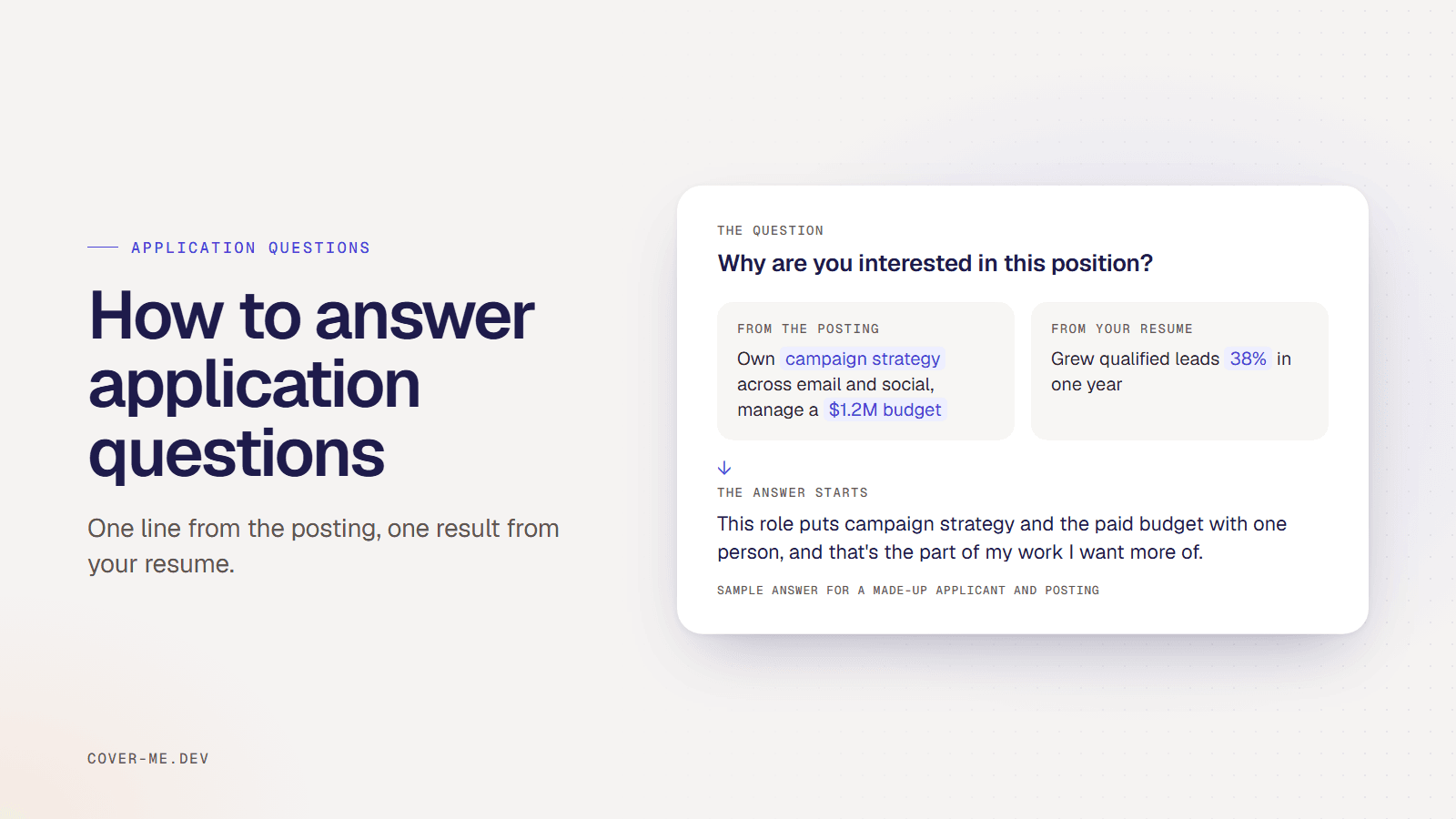
To answer “Why are you interested in this position?”, name the one part of the job you most want to do and why, in your first sentence. Then back it with one or two results from your resume. Skip praise for the company’s mission and don’t list the posting’s requirements back. Three or four sentences fits most form boxes.
Recruiters notice when many applicants answer it the same way. A recruiting manager at Zapier told HuffPost UK that applicants sent her the same word-for-word answer to it, starting “Company’s mission of ‘insert mission statement’ resonates with me”. “After seeing this exact same response over and over again,” she said, “it becomes clear that the candidates are all using AI.”
What the employer is checking
Whether you know what the job is, and whether you’ve done that kind of work. The UK Civil Service, which publishes how it reads applications, says a good one shows “how your skills and experience align with the role” and “what motivates you to do your best work”.
How to answer
- Pick the one part of the job you most want to do, and say why in your first sentence.
- Find one or two results on your resume that show you’ve done that part already. Use the real numbers.
- Stop there. Don’t list the posting’s requirements back as proof you fit. Your results already show it, and a form box is not a cover letter.
Sample answer
This role puts campaign strategy and the paid budget with one person, and that's the part of my work I want more of. At Brightline I led campaign strategy across email and social that grew qualified leads 38% in one year, and I manage a $1.2M paid media budget across four channels, where I cut cost per lead 22%.
It never says “passionate” or praises Northwind. The reason is in the first sentence, and the results are what make it believable.
How to answer “Why do you want to work here?”
To answer “Why do you want to work here?”, give one reason about this company that wouldn’t fit any other, such as what it sells or who its customers are, and say why it matters to you. Then back it with one thing you’ve done. If the reason would fit any company, it isn’t a reason yet.
It sounds like the question above, and many applications ask only one of the two. The difference is the subject: that one is about the job, this one is about the company.
What the employer is checking
Whether you picked this company or would send the same answer anywhere. A reason that fits any company tells them the second.
How to answer
- Find something specific to this company: what it sells, who buys it, or a problem the posting says it has. The posting and the company’s own product pages are enough. You don’t need inside knowledge.
- Say why that matters to you, in your first sentence. Name the company fact in a few words and spend the rest on your reason. They know what they sell.
- Back it with one thing you’ve done that fits.
Sample answer
Northwind sells to independent clinics, and I want my marketing to reach the person who runs the practice and makes the call. Email is how I've done that best: at Juniper Labs I wrote and scheduled a weekly newsletter for 40,000 subscribers with a 41% open rate.
This example answer works because its reason fits Northwind, not any employer, and the newsletter result shows Alex has done that kind of work. If the only reason you can find is the company’s mission statement, write about the job instead. A true answer about the work reads better than borrowed praise.
What ChatGPT wrote for these two questions
On November 23, 2026, I asked ChatGPT (logged out, on chatgpt.com) each of the two questions above five times, each time in a new chat. The prompt was “I’m applying for this job. The application form asks: [the question] Write my answer for the form box.”, followed by Alex Rivera’s resume and the Northwind posting. The posting has a one-line mission statement, which invites the mission praise counted below.
| What the answer did | Why are you interested in this position? | Why do you want to work here? |
|---|---|---|
| Praised Northwind’s mission | 5 of 5 | 5 of 5 |
| Said “excited” and “meaningful” | 5 of 5 | 5 of 5 |
| Said “passion” | 4 of 5 | 0 of 5 |
| Opened with the exact first sentence of another run | 3 of 5 | 3 of 5 |
| Listed three or more results from the resume | 4 of 5 | 5 of 5 |
| Added a patient benefit the posting doesn’t state | 3 of 5 | 2 of 5 |
| Claimed HubSpot, which the posting asks for and the resume doesn’t have | 0 of 5 | 0 of 5 |
Three of the five answers to “Why are you interested in this position?” began with the same sentence, word for word:
I’m interested in this position because it closely aligns with my experience in B2B marketing and my passion for building campaigns that deliver measurable results.
Three of the five answers to “Why do you want to work here?” began with this one:
I want to work at Northwind because I’m excited by the opportunity to use marketing to make a meaningful difference for independent clinics.
This test used one resume and one posting, so it can’t show what many applicants get. It is consistent with the repeats the Zapier recruiter saw.
The drafts were accurate about Alex. ChatGPT kept to the resume’s numbers and didn’t claim HubSpot, which the posting asks for and Alex doesn’t have. Three of the five answers to “Why do you want to work here?” picked a fair reason, too: who Northwind sells to. The other two gave the mission itself as the reason. What made the answers read alike is the wording around the reason. Every answer praised the mission and said “excited”, and nine of ten listed three or more results from the resume, where the advice above says to skip the mission praise and keep one or two results. Half of them also added a patient benefit the posting doesn’t state.
If you start from a ChatGPT draft, keep its reason only if it’s true for you and isn’t the mission, and rewrite it in your own words without “excited”, “passion” or “meaningful”. Then cut the mission praise, keep one or two results, and check every claim about the company against the posting.
“Tell us about yourself” on a job application
On a job application, answer “Tell us about yourself” in three or four sentences: what you do now and for how long, one result that matches the posting, and why you’re applying. Leave out your life story and anything the form already asks for, such as your school or address.
On a form, this isn’t the two-minute spoken version. The reader has your resume open beside it.
What the employer is checking
Whether you can pick the parts of your background that matter for this job, and say them briefly.
Sample answer
I'm a marketing lead with seven years in B2B demand generation, now at Brightline. I plan campaigns across email, social and search, and my A/B tests on landing pages lifted sign-up conversion from 3.1% to 4.4%. I'm applying because I want to bring that work to a company that sells to independent clinics.
How to answer desired salary on a job application
For desired salary on a job application, check the posting for a pay range first, then give a range whose bottom is the figure you want, such as $90,000 to $100,000. If the field takes only a number, put your target. The question asks what you want, not what you earn now.
California, Colorado, Washington, British Columbia and Ontario are among the places that now require a pay range in the posting, and an answer inside it is the easy case.
What the employer is checking
Whether you fit the budget for the role. New York’s guidance says “An employer may ask an applicant for their salary expectations for the position”, while the same law bars asking for pay history. California and Washington have similar bans (California, Washington).
How to answer
- Give a range whose bottom is the figure you actually want. In five negotiation experiments, opening with a range like that got better final terms than a single number, as long as the range wasn’t too wide (Ames and Mason, 2015). Those were negotiations, not application forms, so treat it as a guide.
- If it asks for your current salary, you can answer with your expectations instead. Where the law allows the question, sharing your pay history is your choice.
Sample answer
$90,000 to $100,000, depending on the full benefits package. That sits in the upper half of the range in your posting.
How to answer reason for leaving on a job application
For reason for leaving on a job application, write one true sentence about what you want next, not about what went wrong. If you’re still employed, say so. If you were laid off, write “Position eliminated”. Don’t criticize the employer.
Applications ask this for your current job and sometimes for each past one. It has the shortest good answer of the five, and a plain one reads better than a vague one.
What the employer is checking
Whether something went wrong that could go wrong again, and whether you’ll talk about a past employer badly.
How to answer
“Laid off in a reorganization” works as well as “Position eliminated”. Layoffs are common, and the reader knows it. Criticism of a past employer is what the reader remembers, because they only hear your side.
Sample answer
I'm still at Brightline. I'm looking for a role where I own the whole campaign plan for one product.
Write a first draft in the box
I build Cover Me, a Chrome extension that can write a first draft of these answers for you to edit. On the application, right-click the question box and choose “Cover Me: write an answer”. It reads the question and the job posting on the page, or the job you last saved in Cover Me, writes an answer from your resume, and types it into the box. You edit it there, ask for a change such as Shorter, or press Ctrl+Z to undo.
The answer comes first, and every fact in it comes from your resume or what you’ve told Cover Me about yourself. Details such as your salary or start date stay in [brackets] for you to fill in. Check the draft against the advice above before you use it. It never submits the form. Free accounts get 5 answers to start, then 5 a week, Pro gets 50 a day, and there’s no limit with your own API key. You can install it below.
For the rest of the application, see how to tailor your resume to a job description and the ChatGPT cover letter prompts.
Frequently asked questions
How do you answer "Why are you interested in this position?"
Name the one part of the job you most want to do, and why, in your first sentence. Then give one or two results from your resume that show you have done that work. Leave out praise for the company's mission, and don't list the posting's requirements back. Three or four sentences is enough for most form boxes.
How do you answer "Why do you want to work here?"
Give a reason about this company that wouldn't fit any other, such as what it sells or who its customers are, and say why it matters to you. Then back it with one thing you have done. If the only reason you can find is the mission statement, write about the job instead.
How do you answer "Tell us about yourself" on a job application?
Write three or four sentences: what you do now and for how long, one result that matches the posting, and why you are applying for this job. Skip your life story and anything already in the fields above it, such as your address or school.
What should you put for desired salary on a job application?
Check the posting for a pay range first. California, Colorado, Washington, British Columbia and Ontario are among the places that require one. Give a range whose bottom is the figure you want, such as $90,000 to $100,000. If the field takes only a number, put your target. An employer asking for your desired salary is not asking for your current pay, and some places, including California, New York and Washington, bar employers from asking for pay history.
What should you put for reason for leaving on a job application?
One true sentence about what you want next, not about what went wrong. If you are still employed, say so. If you were laid off, say "position eliminated" or "laid off" plainly. Don't criticize a past employer, since the reader can only hear one side.