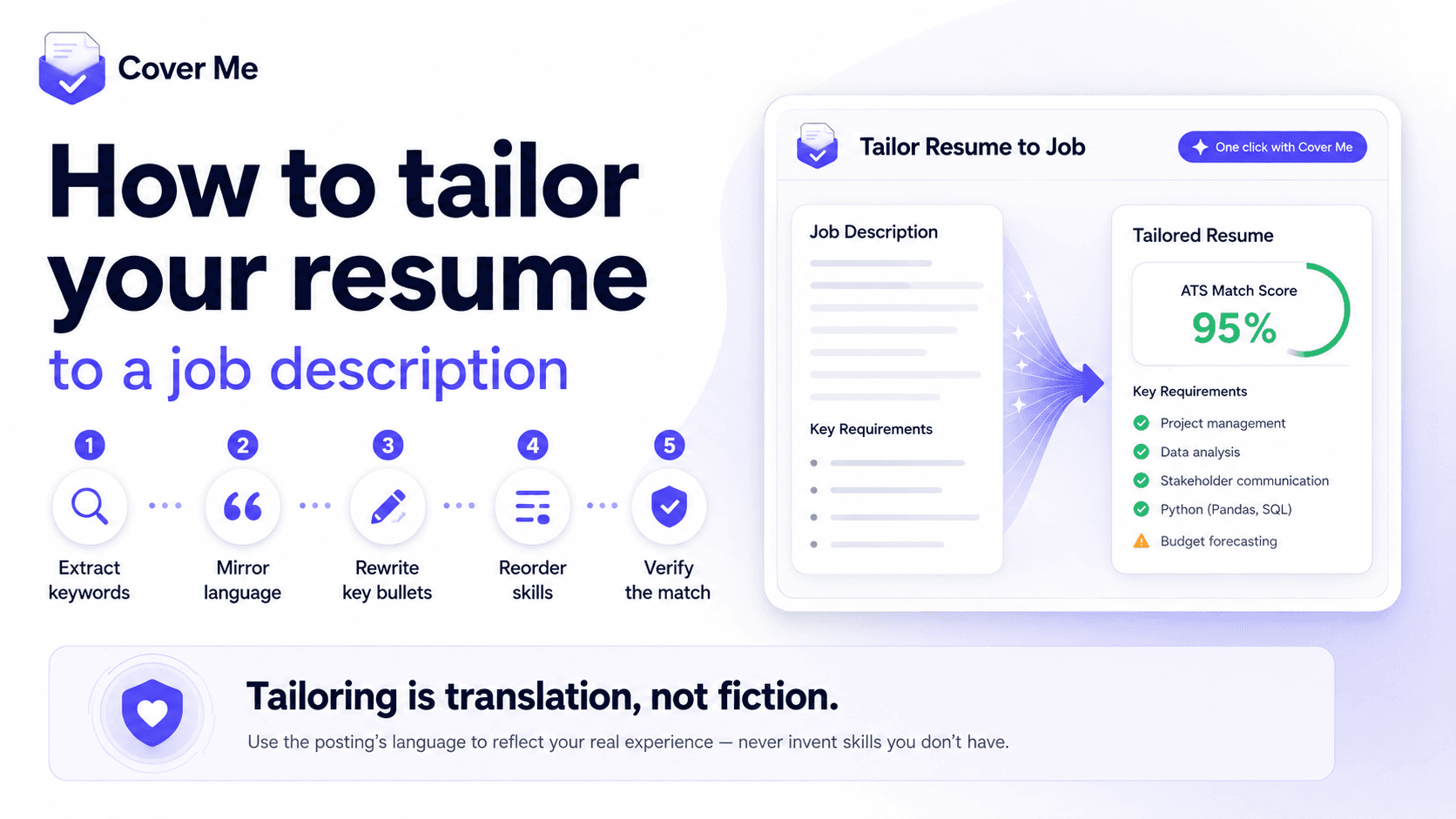
Tailoring a resume means rewriting it for one specific job posting: mirroring the posting’s keywords where they truthfully describe your experience, leading with the most relevant accomplishments, and cutting what doesn’t serve this role. It matters because applicant tracking systems filter resumes by keyword match — a strong candidate with an untailored resume is routinely invisible.
Here is the five-step method, followed by the honest caveats — including what you should never do.
The five-step method
- 01
Extract the keywords that matter
Read the posting twice. Highlight the hard skills, tools, and qualifications that appear in the requirements — especially anything mentioned more than once or listed as “required”. Those repeated terms are what recruiters filter by in the ATS.
- 02
Mirror the posting’s exact language
ATS keyword matching is often literal. If the posting says “React”, write “React”, not “modern JavaScript frameworks”. If it says “stakeholder management”, use those words — provided they truthfully describe your experience.
- 03
Rewrite your most relevant bullets first
Don’t rewrite everything. Take the 4–6 experience bullets most relevant to this role and lead them with the matched skills, keeping your real metrics and outcomes. Recruiters skim top-down; your strongest matches should appear early.
- 04
Reorder your skills section for the role
Move the skills this posting asks for to the front of your skills list, and cut skills that add noise for this particular application. A skills section is per-application real estate, not a permanent inventory.
- 05
Verify the match before submitting
Score your tailored resume against the posting — manually by checklist, or automatically with a tool that shows an ATS match score and lists gaps. Fix what you truthfully can, and accept the gaps you can’t.
The line you must not cross
Tailoring is translation, not fiction. Re-expressing “built dashboards used by leadership” as “stakeholder reporting and data visualization” is honest tailoring — the experience is the same, the language now matches the filter. Adding “Kubernetes” because the posting wants it and you once watched a talk is fabrication. It passes the ATS, then costs you the interview, and sometimes the offer you already had.
The practical test: could you speak about this bullet, as written, for two minutes in an interview? If not, it doesn’t belong on the tailored resume.
Doing it in one click
The method above takes 20–30 minutes per application done well — which is why most people stop tailoring after the third application of the day. The Cover Me Chrome extension automates exactly this method: on any job posting, “Tailor Resume to Job” extracts the role’s keywords, rewrites your bullets in the posting’s language under a hard constraint against inventing skills or changing your job history, then shows your ATS match score with each requirement marked matched or gap. It works on LinkedIn, Indeed, Greenhouse, Lever, Workday, and Ashby, and exports a formatted one-page PDF when the role demands it.