
ChatGPT cover letter prompts that drop the AI phrases
These four ChatGPT cover letter prompts write a letter from your resume and the job posting, then strip the phrases that make it sound AI-written and check every claim. They work the same in Claude. I ran each one in both, and the answers below are what came back.
Lincoln Laylor8 min read
TL;DR
- Ask for the three points first, each backed by a line of your resume, then the letter.
- Name the AI phrases to cut, and ask for a plain sentence about the role in place of each one.
- Check every claim, and read the corrected letter too, since the fix can add new filler.
How I tested them: on November 18, 2026, I pasted a made-up resume (Alex Rivera, a marketing lead) and a real public posting, Datadog’s Senior Demand Generation Marketing Manager, into ChatGPT (logged out, on chatgpt.com) and Claude (Sonnet 5.5, through Anthropic’s API). Each prompt went into the same chat as the one before it. The placeholders in brackets are what you replace. To tailor the resume itself first, use the ChatGPT resume prompts.
The four prompts, with real answers
01Pick what the employer cares about most
Here is a job posting and my resume. Pick the 3 things this employer cares about most. For each one, quote the line of my resume that shows I've done it. If nothing in my resume shows one, say so instead of stretching another line to fit. Job posting: [PASTE THE JOB POSTING] Resume: [PASTE YOUR RESUME]
Check each rating against its quote. ChatGPT rated the same email and social line “strong evidence” for campaigns across webinars, events and content, then listed webinars as a gap later in the same answer. A letter built on a stretched match makes a claim you’d have to defend in the interview.
02Write the letter from those points
Write a cover letter for this role from those 3 points. Keep it under 250 words, in 3 short paragraphs. Open with why I want this role, not with "I am writing to apply". Use only facts from my resume and keep my numbers exactly. Sign it with my name.
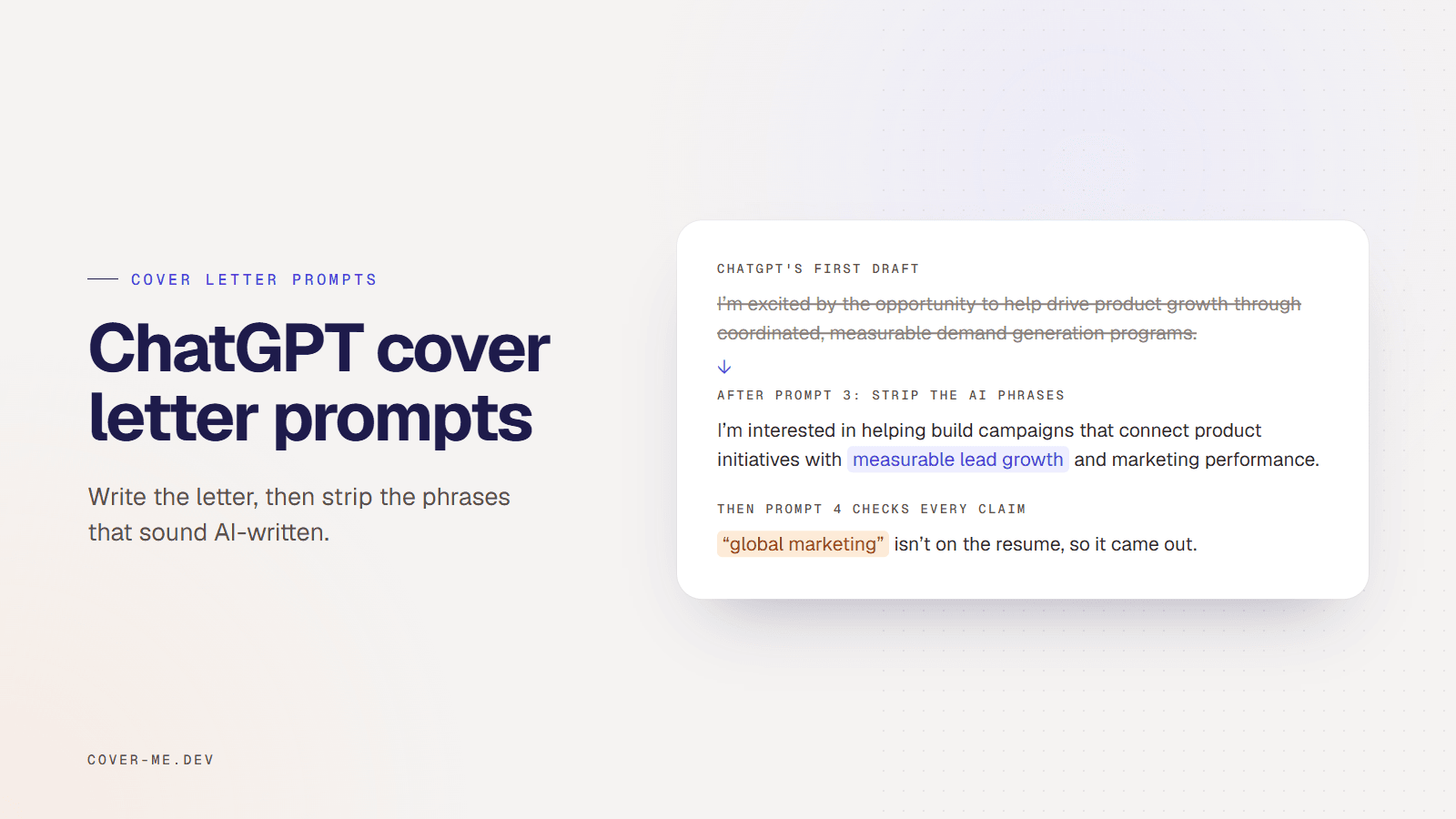
Check that the numbers match your resume, then count the stock phrases. Every number here is right, but the draft says “I’m excited” twice, and its last paragraph would fit any marketing job at any company.
03Strip the phrases that sound AI-written
Edit the letter to remove phrases that sound AI-written: "I am excited", "I am writing to express", "passionate", "thrilled", "leverage", "proven track record", "dynamic", "fast-paced", "align with", "I believe", "Furthermore", "In today's", dashes used as commas, and any sentence that would fit any company. Replace each one with a plain sentence about this role. Don't add facts. Show only the final letter.
Read it once more for lines that would fit any company. Both “excited” lines are gone, but the edit swapped “My experience combines multi-channel campaign execution” for “These experiences have given me hands-on experience managing campaigns, budgets, and cross-functional launch activities”, which is just as generic and repeats the sentences before it. Cut a line like that yourself.
04Check every claim against your resume
Check the letter against my resume. List every skill, tool, number or claim my resume doesn't support, quote the sentence it's in, and say what my resume actually says. If everything is supported, say so. Then give me the corrected letter.
Read the corrected letter too, because a fix can bring new filler. This one added “I look forward to contributing to the team’s efforts”, the kind of stock closing prompt 3 tells the model to cut. The check also can’t know what your resume leaves out: if you did work with product marketing, put it back in your own words.
What this costs for every application
The waiting is short. Claude took 40 seconds for all four answers, and ChatGPT took 26. The rest is yours: paste in the posting and your resume, read about 1,000 words of answers (4 to 5 minutes at an average pace), cut what the edit missed, and copy the letter into a document. If you also tailor your resume, that’s a second set of prompts and another 1,000 words for the same application.
When I wrote my own applications in ChatGPT, a letter and a tailored resume took about 12 minutes per application. That’s fine for a few roles a week, and it adds up fast at several a day.
How Cover Me does the same steps
I build Cover Me (cover-me.dev), a Chrome extension that writes the letter from the posting page. You upload your resume once. On a posting, “Generate Cover Letter” reads the page and writes from your resume and the posting, in about 20 seconds.
Part of prompt 3 is built in, with the checking done in code. Every letter is scanned for stock AI words and clichés, generic openers like “I am writing to apply”, and passive closes. It also flags any dollar amount, percentage or figure of three digits or more that isn’t in your resume, your candidate context or the posting. When it finds a problem, Cover Me sends the letter back to the model once with each one listed, and keeps the new version unless it has more.
ChatGPT and Claude can write a good letter, as the answers above show. The difference is the copying and checking you do by hand. If you’re deciding between a chatbot and a tool, Cover Me vs ChatGPT compares them.
Frequently asked questions
What is a good ChatGPT prompt for a cover letter?
Split it into four prompts in one chat. First ask which three things the employer cares about most, with a quote from your resume for each. Then ask for a letter under 250 words from those points, then an edit that removes the phrases that sound AI-written, then a check of every claim against your resume.
How do I make a ChatGPT cover letter not sound like AI?
Ask for an edit that names the phrases to remove, such as "I am excited", "passionate", "leverage" and "proven track record", and any sentence that would fit any company. In my test that removed the stock lines from the first draft, but the edit wrote a new generic sentence in place of an old one, so read the result yourself.
Can I use Claude instead of ChatGPT for a cover letter?
Yes. I ran the same four prompts in both. Claude's first draft had fewer stock phrases, and both checks found a claim the resume didn't support. Either works if you check the letter before you send it.